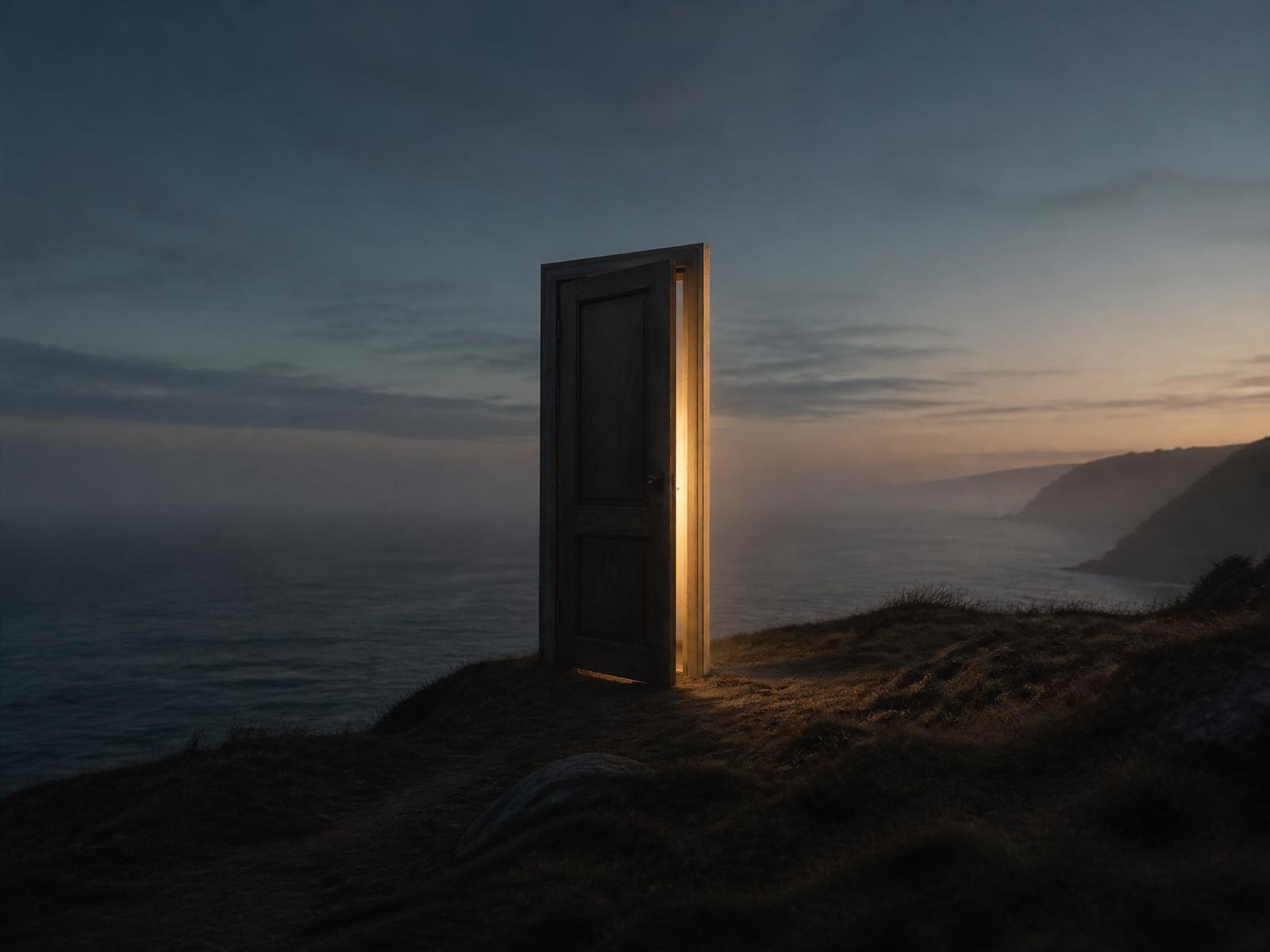
Keeping Doors
Open.
On commitment, identity, and the quiet cost of refusing to choose.
Cornerstone Work · Foundations · 8 min read
A man stood in a long hallway.
Doors on either side, all slightly open.
He had been standing there for years.
Through each door, a different light. A different city, a different love, a different life. He could see them all, and because he could see them, he believed he was free.
He had not stepped through any of them. To step through one would have been to stop seeing the others. And so he stayed in the hallway, keeping every door ajar with the quiet industry of a person who thinks he is preserving his future.
A life of open doors is not a life of possibility.
The hallway is seductive. Keeping options alive feels like wisdom. Waiting feels like maturity. The person with many doors open looks, from the outside, like the person with the most freedom.
But a hallway is not a room. It is a passage mistaken for a home. The person who lives there is not traveling toward anything. He is refusing to arrive.
Every open door is a world held at arm's length. A life composed of such worlds is not abundance. It is a life that has not yet been lived.
What every open door quietly takes.
An open door is never free. The cost is not itemised, but the ledger runs whether or not you look at it.
It takes depth. Nothing planted shallow ever roots. A dozen half-tended paths cannot rival one path walked far enough to change the walker.
It takes identity. A person who will not choose remains a collection of tendencies. Choice is what turns tendencies into a self.
It takes presence. A part of you is always elsewhere, rehearsing the door you have not closed. You are rarely fully where you are.
Optionality preserves the future you could have.
Commitment builds the future you will.
What kind of person is formed by commitment?
Identity is not something you find. It is something you become, one closed door at a time. Every vow draws a line around the self. Every refusal to choose blurs it back into fog.
The people who carry weight are rarely the ones with the most options. They are the ones whose commitments have made them legible. A craftsperson. A parent. A friend who stays when it is hard. Their shape comes from what they refused to keep open.
You do not have a self so much as a set of things you have chosen to be for.
Commitment is not a cage. It is a shape.
The modern imagination treats commitment as loss — of freedom, of possibility, of the other lives one could have led. This is a failure of perspective. A river without banks is not more free. It is only a flood.
A vow narrows your future. And for the first time, it makes the future yours. The person you are becoming is built not from the options you keep alive, but from the options you were willing to let die.
Constraint is not the opposite of a rich life. It is the shape of one.
“A life is not built from the options you keep.
It is built from the ones
you were finally willing to close.”
The doors close by themselves.
At some point — sooner than you think — the invitations are quietly withdrawn. The person moves on. The season ends. The door that once stood open is simply no longer there.
What remains is the life you actually built. Not the one you considered. Not the one you kept available. The one you entered, and stayed inside.
There is no framework for this. There is no method. There is only the quiet recognition that a meaningful life is not the sum of its possibilities. It is the residue of what was chosen, and stayed chosen.
Every choice I avoid is quietly shaping the person I become — the one still standing in the hallway, watching doors that will not stay open forever.
Continue the conversation
If this perspective made you think of someone—a partner, colleague, friend or fellow leader—share it with them.
Some ideas are worth thinking about together.
Questions to explore
On your own
Which door are you keeping ajar, and what would it mean to close it?
With another person
What has each of you already chosen, deeply enough that it shaped you?
In a room together
What are we refusing to commit to, and who is paying for the delay?
- Previous Perspective
Why Most People Don't Need More Information
On information abundance, the hidden cost of indecision, and clarity as the real advantage.
Continue reading - Next Perspective
Human + AI
A philosophical field guide for living well alongside intelligent machines.
Continue reading - Related Perspective
The Life You Build
On building without becoming separated from oneself — the closing cornerstone work of Perspectives.
Continue reading